
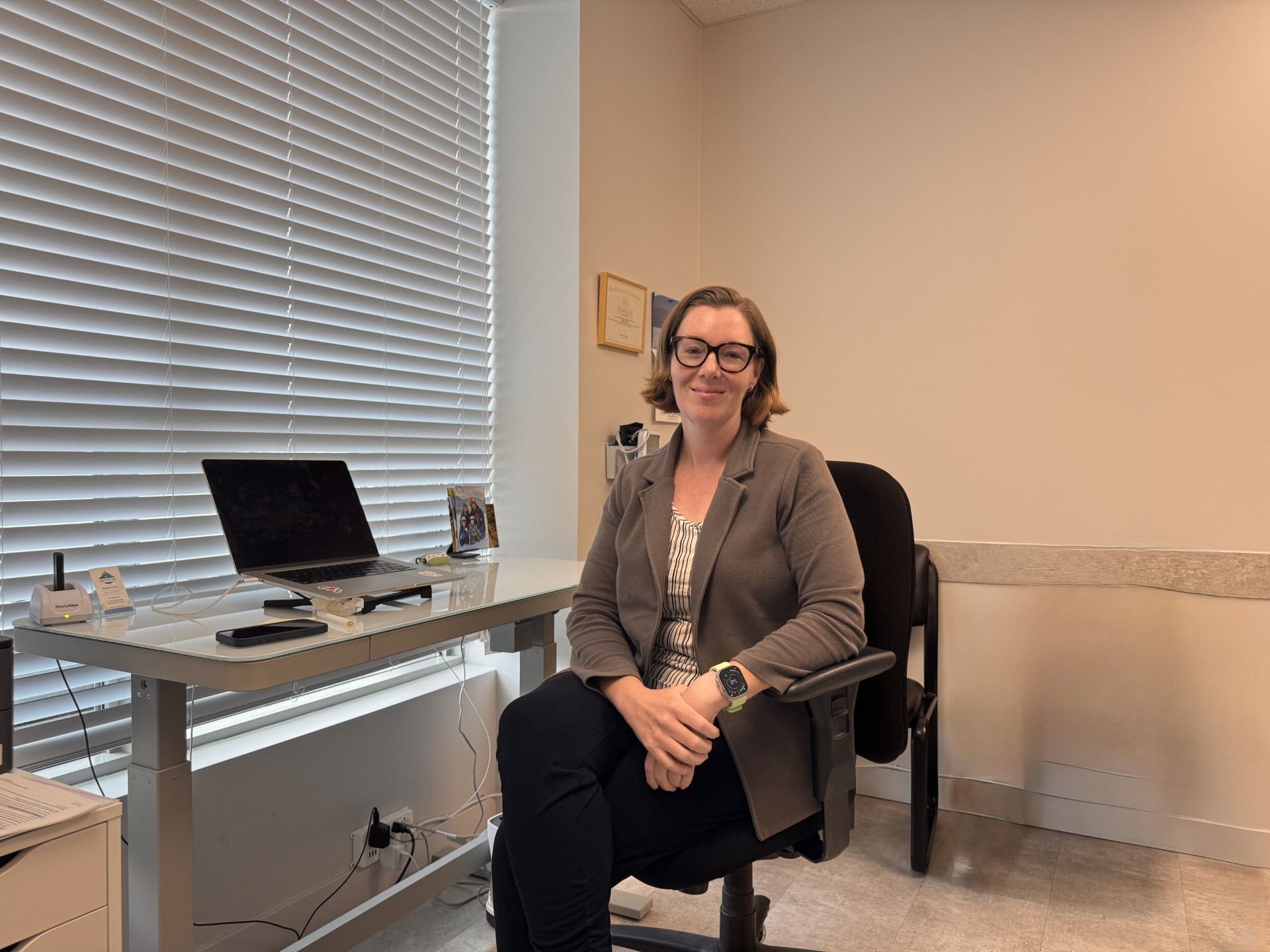
Dr. Caroline Cook, family doctor and medical director at Abbotsford Medical Centre, is helping pave the way for internationally trained medical doctors to find a home for their practice in Abbotsford as the physician lead for Abbotsford Division's IMG recruitment program.
How Abbotsford is flipping the script on physician recruitment
By Mari-Len De Guzman
In Abbotsford, there are many international medical graduates (IMG) who have chosen to set up practice in the community. And the reason may be less about geography and more to do with a dynamic physician recruitment program founded on relationships and engagement.
Launched in late 2022, the Abbotsford Division of Family Practice’s strategy for new physician recruitment and integration, including for IMGs, is a comprehensive, coordinated pathway designed to support physicians entering the community through programs like the provincial practice-ready assessment (PRA) and the UBC return-of-service (ROS) pathways.
For Dr. Caroline Cook, Abbotsford Division’s IMG physician lead, the work is a little personal. As an IMG herself, completing medical school in England, Cook experienced first-hand the challenges facing international graduates navigating the physician placement system in British Columbia.
“I saw a massive opportunity to improve how we welcome these doctors,” Cook recalled.
Abbotsford has a history of attracting internationally trained physicians. Currently, 47 per cent of family physicians in the city finished their medical degree outside of Canada. Welcoming more IMGs into the community comes almost naturally.
And it starts with building relationships and fostering engagement with medical students long before they start their first year of residency.
“Identifying candidates who want to come to Abbotsford earlier in their process is a really important piece,” Cook explained.
The Abbotsford Division’s recruitment team then begins a systematic outreach process that includes touchpoints throughout the students’ med school journey. In fact, the Division’s IMG strategy was borne out of one of these outreach events – the Abbotsford Medical Student Mixer – an annual event that brings together med students, residents and preceptors to connect and engage in a relaxed atmosphere.
“We support IMGs to have a stronger application and be more successful about landing a residency spot. By then, you already have connections with them so that when they’re done residency and they’re considering where to work, they’re coming to Abbotsford and saying, ‘This is where I want to be,’” Cook said.
Relationship-based, personalized recruitment

More than 80 percent of doctors who had their residency in Abbotsford choose to stay and make a home here for their practice, thanks to the Division’s tested and proven relationship-based approach. And the numbers speak for themselves. In the last fiscal year alone, Abbotsford successfully welcomed 26 new family physicians to the community, including IMGs and locums. The work took far more than just a recruitment blitz; the Division provided individualized, high-touch integration support to each candidate.
“It is very much about letting the candidate choose where they want to work,” Cook explained, referencing the Division’s collaborative recruitment framework led by its people and culture manager Marz Hussain.
“The new physicians are presented with some clinics who are recruiting, and then they get to choose what’s the best fit for them. We basically tell them, ‘You have choice, you have control,’ that’s a big selling feature,” Cook added.
Even before hiring clinics are presented to the candidates, Hussain and the recruitment team conduct a deeper dive into the recruitment process, where both clinics and candidates are assessed for high-suitability match.
“We don’t just present the prospective physicians with a list of clinics that are hiring. It’s a more personalized approach, where each candidate will be matched with specific clinics that best fit their values, their passion, and their lifestyle,” Hussain said.
That support continues beyond recruitment, she added. Recognizing that navigating the complex process of provisional licensing and IMG pathways can be challenging and overwhelming, the Division steps in early to smooth over the roadblocks.
“We provide the new doctors hands-on help with contract navigation, billing education, and workflow planning before they even step through the clinic doors,” Hussain said.
Ultimately, this recipe does more than just make incoming physicians feel welcome; it stabilizes care for the entire community.
Filling the attachment gap
For Cook, it was important to have a sustainable system for physician recruitment, which meant empowering the candidates to choose what feels right for them. This is especially consequential for ROS physicians.
“Having a good plan for placements of IMGs would serve our community well. Because if we did a bad job, we wouldn’t be able to retain the person that was placed with us. So, I’m very thankful that the Abbotsford Division has highlighted that as a strategic priority,” Cook said.
Stepping into the role of IMG physician lead has allowed Cook to turn her own early professional hurdles coming in as an IMG into a blueprint for the next generation. For her, the work is a rewarding blend of advocacy and community building.
“I do enjoy it, and I think it’s meaningful,” Cook reflected. “Other communities don’t always make this a priority, but they should. It is an incredibly important recruitment strategy.”
Part of her work involves standing as a familiar, empathetic voice for residents who might feel overwhelmed in a sea of legal and contractual jargon. When Cook represents the Division at provincial information nights, her presence as a practicing physician offers a rare and highly valued perspective for prospective candidates.
“When I go, I can say to them, ‘Look, I came through this. I was in your shoes,’” she said. “I can speak to exactly how the return of service is done, because often they aren’t given a lot of information, mostly just legal and contractual-type stuff.”
Looking ahead, Cook hopes to expand the program and deepen its sustainability. As British Columbia’s population continues to climb, she recognizes that traditional local avenues for training doctors cannot keep up with the growing attachment gap. The only viable path forward, she believes, is to double down on supporting international graduates and making Abbotsford synonymous with world-class integration.
“They’re trying to train more doctors to fill the attachment gap, but so far, it’s not been successful. I believe they need to continue to increase the number of spots for these IMG programs.”
Ultimately, Cook envisions a self-sustaining ecosystem where the doctors the Division recruits today become the champions who attract the doctors of tomorrow.
“If Abbotsford is known as a good, highly supportive place to come and work for IMGs, and we have more of them working here and sharing that message, it will just continue to be a positive experience,” Cook said. “Our attachment gap won’t be as bad, and we can continue to enhance the process and retain our people.”